
Cyclospora is a perfect storm for our highly consolidated food system.
Since late June, Cyclospora cayetanensis has dominated food conversations in the US. The tiny single-celled parasite causing explosive gastro-intestinal distress in 49 states is elusive and resilient.
Cyclospora finds its way into fresh produce every summer, going back to the 1990s. It is now endemic in tropical and subtropical regions where quite a lot of food is grown and processed. Once shed in human feces, it requires a week or two in warm, humid outdoor conditions to mature and become infectious to others. Rising global temperatures have made it easier for cyclospora to spread, and it can survive in the environment for months.
Under these conditions, agricultural water can be contaminated. Cyclospora can be inadvertently applied to plants through irrigation water and pesticide mixing. However, in this case, it likely entered our food supply through the water used to wash your produce, which is why that triple-washed bag lettuce is riskier than a head of romaine.
Bleach and other sanitizers don’t kill it (although cooking does), and its sticky coating enables it to lodge in folds and crevices of produce (such as lettuce, raspberries, blueberries, fresh herbs, and snap/snow peas).
While this particular cyclospora outbreak appears to have wound down, the pathogen is not disappearing.
Consolidation increases consumer risk
Taylor Farms, at the center of the current outbreak on iceberg lettuce, is not really a farm – it’s actually a grower-shipper-packer, just like its massive market competitors. Only 25% of produce marketed under their name comes from fields they own. The other 75% comes from 280 contract farms.
Their operations are responsible for 40% of all salad kits in the country, sold at almost every grocery store. They also supply several fast food restaurants and Sysco, a major supplier to restaurants, colleges, and homes for older adults.
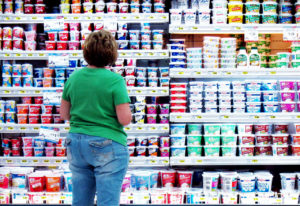
Taylor Farms is just one of four grower-shipper-packers that controls 54% of the fresh-cut salad market. Walk into any major grocery store, and you’ll be hard-pressed to find salad that does not come from Cultrale-Safra, Itochu, Taylor Fresh Foods, or Bonduelle – under an array of brand names.
The real problem here is not one individual company or another. Cultrale-Safra’s brand Fresh Express was responsible for a 2018 cyclospora outbreak. Itochu recalled Dole-branded blueberries in 2021 for suspected cyclospora contamination. We’ll spare readers the list of E. coli, listeria, and salmonella-related recalls among these companies over years.
Instead, it is the complexity of our food system, which involves untold farms and handlers, that increases the risk to our health. Outbreaks originating with grower-packer-shippers reverberate widely across the food system because distribution is so vast. That’s how the US came to have 24,000+ confirmed and suspected cases of cyclosporiasis this summer.
You’d be in good company to wonder why every sector in agriculture is dominated by a few companies. Who benefits, aside from wealthy company leaders and shareholders? Not farmers. Huge retailers like Walmart, Costco, and Amazon require enormous shipments of produce (and everything else they sell) to keep their shelves stocked. After all, shoppers in the US spend almost 20% of our grocery money at Walmart alone!
Big Retail doesn’t source produce from local farmers. It’s far more efficient to work with a few grower-shipper-packers.
An agonizingly slow response
Why did it take so long for Taylor Farms and the government to acknowledge what was happening?
First, cyclospora takes up to two weeks to wreak havoc in the gut after it enters a host. Even when our food safety system is operating at its best, cyclospora outbreaks are seldom tracked back to their origins with certainty. Do you know exactly what you ate two weeks ago? But warnings came very slowly this year.
The Trump administration cut funding for multiple federal and state agencies tasked with responding to food-borne illnesses in 2025. Multi-state outbreaks like this one can only be effectively controlled when federal and state agencies work together, and experts have raised the alarm about gaps in food safety. The FDA did recently publish voluntary guidance for preparation and packaging of fresh-cut produce, although it’s up to processors whether to follow it.
It’s no wonder food shoppers trying to respond to this outbreak feel powerless. But getting to the bottom of any crisis in our industrial food system can be an exercise in futility. In discussions with our advisors, we were told that “large aggregator supply chains are a black hole of consumer knowledge.”
What You can Do
Know your farmer, know your food!
Knowing who grew your produce and where it was grown allows you to make more informed decisions about food safety. No farm is immune to food safety issues, but buying directly from a farmer means you can get answers to your questions and respond faster if there’s a problem.
Find an organic farm in your community on the Local Harvest website and shop your local co-op or independent retailer. Seek out certified organic, soil-grown berries with our Local Organic Berry Map. Go to the farmers market. You will not only keep your money circulating in your own community, you will get fresh and delicious food that you can feel safe eating.
By putting our energy and care into buying local food and supporting community-scale farmers whenever possible, we can build our food future together!
When you can’t know your farmer?
Experiment with a more biodiverse diet. Sautee some kale, swiss chard, or beet greens. Try tender leaves of dandelion greens or nettles from your yard.
Although the threat-level is dropping, you can see if a product in your refrigerator is connected to Taylor Farms using this barcode scanner.